Maurice Ravel French composer
Move the tag to where you think it belongs, then drop it.
Try another
Your brain tends to make the past feel much closer than it really is. It is called the telescoping effect.
What happened while their lives overlapped?
Ravel grew from a newborn into a composer while Dvořák was still alive. One surviving Dvořák sketch can be dated only to 1876 or 1877; later milestones have exact year evidence.
1875 to 1904: 29 years. This is the stretch of time when both were alive.
This expands the highlighted stretch of the timeline above. Each event sits at its date: a dot is a known date, a diamond an approximate one, and a bar a range of possible years. An unfinished quartet sketch survives
A one-page sketch preserves Dvořák’s unrealised idea for a string quartet in C major.
Estimated date: 1876 to 1877. The surviving page is not fully dated, so the catalogue gives two possible years. It is 1 to 2 calendar years after the interval begins.
Source: Academy of Classical Music, National Library of the Czech Republic
Slavonic Dances is published
Simrock publishes the first series for piano four hands. An orchestral version follows later that year.
Source: Academy of Classical Music
Ravel begins Conservatoire studies
Ravel begins studying piano and harmony at the Paris Conservatoire.
Source: Philharmonie de Paris
The New World Symphony reaches its first audience
The New York Philharmonic introduces Dvořák’s Ninth Symphony at Carnegie Hall, first at a public rehearsal and then in concert.
Source: Carnegie Hall, Carnegie Hall
Ravel completes Jeux d’eau
Ravel finishes the piano piece Jeux d’eau. Its public premiere follows in 1902.
Source: Philharmonie de Paris
Endpoint sources: Philharmonie de Paris; National Museum, Prague
What these are
Maurice Ravel
French composer (1875–1937)
Maurice Ravel was a conductor, a pianist and a composer who lived from 1875 to 1937, a span of 62 years. Recorded as a citizen of France. Known for Daphnis et Chloé, Boléro and Miroirs.
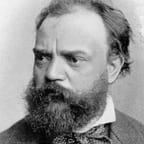
Antonín Dvořák
Czech composer (1841–1904)
Antonín Dvořák was a classical composer, an organist and a professor who lived from 1841 to 1904, a span of 63 years. Recorded as a citizen of Kingdom of Bohemia and Cisleithania. Holder of the position of Member of the House of Lords (Austria). The fields of work on record are performing arts, music education and music composing. Known for Symphony No. 9, Stabat Mater and Saint Ludmila, Op. 71, B. 144.
Picture: Unknown photographer, 1882. Gallica / Bibliothèque nationale de France, via Wikimedia Commons. Public domain. Image source and rights
0 people have guessed so far. The crowd's answer is revealed once 50 more have.